
Florida Public Records Law and Polk County
Florida's public records framework is one of the broadest in the country. It comes from two sources. Article I, section 24 of the Florida Constitution gives every person the right to inspect or copy public records of any branch or agency of state or local government. Florida Statutes § 119.07 adds the statutory layer, requiring custodians to permit inspection and copying at reasonable times under reasonable conditions, and setting the fee rules and exemption procedures agencies must follow. Court records in Polk County carry an additional layer: they are also governed by the Florida Supreme Court's judicial-branch access rules, specifically Rule 2.420, which defines which judicial records are confidential and which are open.
Any person can request Polk County public records. The law does not require you to state a reason, give your name, or be a Florida resident. You just need to describe the records well enough that the agency can find them. Multiple offices in Polk County are separate public record custodians. The Clerk of the Circuit Court & Comptroller holds court records and official records. The Polk County Board of County Commissioners holds county government records. The Polk County Sheriff's Office holds law enforcement records. Each is a separate constitutional officer or agency, so a request sent to the wrong office will not reach the records you need.
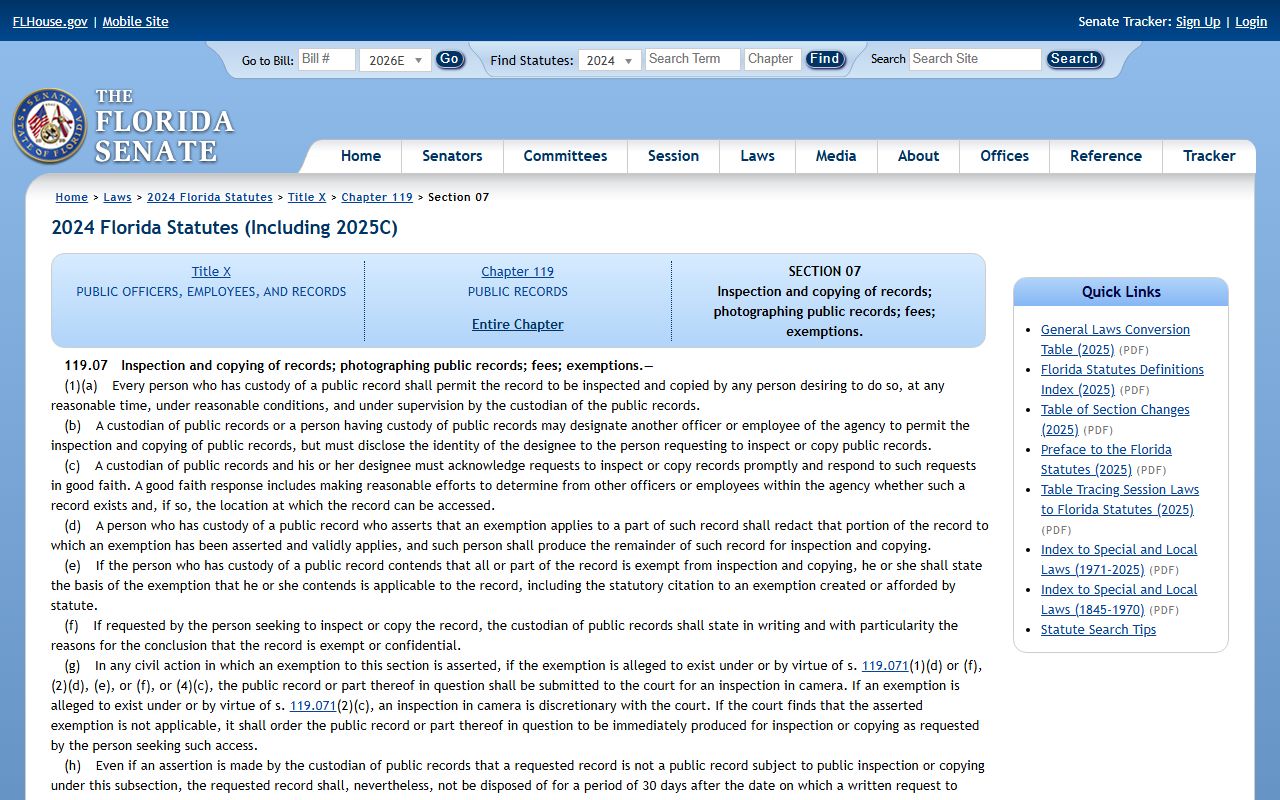
The full text of Florida Statutes § 119.07 on the Florida Senate website sets out how Polk County public record custodians must handle inspection, copying, and fee requests.
What the Polk County Clerk Maintains
The Clerk of the Circuit Court & Comptroller, a constitutionally elected office currently held by Stacy M. Butterfield, CPA, is the central records hub for Polk County. The office manages court records, official records, county commission records, and related services. The Clerk's records landing page at polkcountyclerk.net/Records breaks down the office's holdings into major categories. Court records cover both civil and criminal files from the Circuit Court and County Court. Official records cover property documents that date back to January 1, 1957, in the online system.
The Clerk also handles records outside the courtroom. Marriage licenses are issued and recorded by the Clerk. Final judgments, even those from civil lawsuits, are recorded as official records when they are entered. Property-related instruments, including deeds, mortgages, titles, notices of commencement, liens, and HOA documents, are recorded in the official records system and searched through the official records browser.
- Court records - criminal and civil case files, progress dockets, court dates, charges, filings, and dispositions for both Circuit Court and County Court.
- Official records - deeds, titles, mortgages, liens, notices of commencement, HOA documents, plats, and recorded final judgments; searchable from 1957 forward.
- Marriage licenses and records - issued, performed, and recorded by the Clerk; certified copies available through the records request portal.
- Probate and guardianship filings - wills deposited with the Clerk, petitions, inventories, accountings, and related Probate Division documents.
- County Commission records - board minutes, county ordinances, and financial reports for the Board of County Commissioners.
- Property Fraud Alert records - recording-based notification system for registered property owners.
How to File a Public Records Request in Polk County
A records request is the formal route when you need a copy of a document that is not available through the Clerk's free online search tools. Certified copies of court records, divorce files, marriage licenses, and official records all go through the Clerk's request process. The Clerk's request portal is at polkcountyclerk.net/Request-Record-Copies. For county government records not held by the Clerk, use the Polk County public records request page at polk-county.net/about/public-record-request/, which routes requests and lists contacts for the Records Management Liaison Officer and the various constitutional officers. The RMLO notes that requests for records held by constitutional officers must go to those offices directly.
- Identify the office that holds the record. If it is a court file, divorce record, marriage license, deed, or lien, the Clerk is your starting point. If it is a county government document, use the county RMLO contact or the relevant department. If it is a Sheriff record, contact the PCSO directly at polksheriff.org/contact-us.
- Describe the record as specifically as possible. Give names of the parties, case number if known, approximate date range, and document type. The more detail you provide, the faster the office can locate the file and calculate the cost.
- Submit the request. For Clerk records, create an account at the records request portal and submit online. You can also go in person to the Clerk's office at 255 North Broadway Avenue, Bartow, or call 863-534-4000. For county RMLO requests, use the county's public records page.
- Wait for a response. Under Chapter 119, the agency must respond within a reasonable time. For simple requests, that can be a matter of days. Complex or voluminous requests may take longer, and the agency may ask for a deposit if fees are expected to be significant.
- Pay any applicable fees and receive the records. For plain copies, the Clerk charges $1.00 per page. Certified copies carry an additional certification fee. The Clerk contacts you to complete the process, and payment can be made online or in person by cash, card, money order, or check.
Public Records Request Form Fields
The Clerk's records request portal requires an account and prompts you to fill in information that helps the office locate the right records and contact you. The table below covers the key fields based on the Clerk's documented process. Not every field is labeled as strictly required, but providing more detail speeds up the process and reduces back-and-forth with Clerk staff.
| Field / Element | Type | Required | Notes |
|---|---|---|---|
| Account creation / login | Web account | Required for portal workflow | The Clerk's marriage and records pages note that certified copy requests use the records request portal and require an account; Clerk staff contacts you to complete the process. |
| Record type | Dropdown / selection | Yes | Options include court records, divorce records, marriage license, and official records; picking the right type routes the request to the right division. |
| Case number or record reference | Text | Strongly recommended | Speeds location of the file; without it, the Clerk must search by name and date range, which can increase the search fee at $2.00 per year searched. |
| Party names | Text | Required if no record number | Use legal names as they appear in the case or on the recorded document; a maiden name or alias may be needed if names differ from current legal name. |
| Contact information | Text / email / phone | Required for fulfillment | Clerk staff use this to reach you for payment and delivery questions. |
| Copy type | Selection | Required | Plain copy, certified copy, or exemplified / authenticated copy; certified copies cost more and are required for most legal uses. |
| Payment | Online / in-person / mail | Required where fee applies | Cash, card, money order, or check payable to Polk County Clerk of Courts; credit card service charge applies; domestic relations cash or card only. |
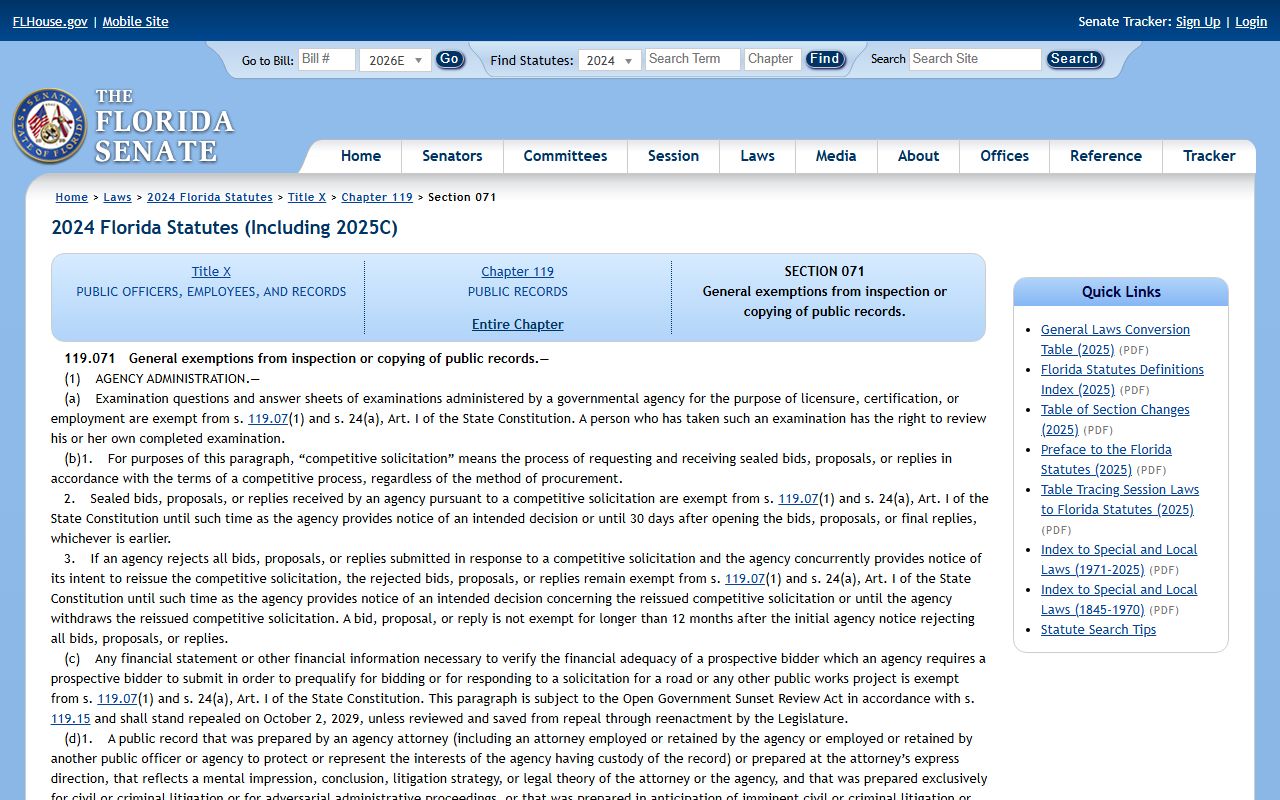
The text of Florida Statutes § 119.071 lists general exemptions that Polk County agencies may cite when withholding portions of a public records response.
Response Timelines for Polk County Requests
Florida's public records law does not set a specific number of days for every response. Chapter 119 requires a response within a reasonable time. What counts as reasonable depends on the complexity of the request, the volume of records involved, and the agency's resources. For a simple court case record that is already indexed and available in the Clerk's system, the response can be fast. For a broad request involving many files or extensive redaction work, it may take days or weeks.
If the response will cost more than a small amount, the agency may ask for a deposit before beginning the search. That is permitted under the statute. Once you pay the deposit, the clock on production begins. If the request is denied in whole or in part, the agency must identify the specific statutory exemption it relies on. A blanket refusal without citing a statute is not lawful under Chapter 119.
You can challenge a denial in circuit court. If you prevail in a records lawsuit, you may be entitled to attorney's fees and court costs under Florida law. For guidance on enforcement, the Florida Attorney General publishes open-government guidance, and the Florida First Amendment Foundation provides additional resources. The key point: most basic Polk County records are not denied. The denial process is the exception, not the rule.
Polk County Public Records Fees
Searching Polk County records online is free. The Clerk's civil portal, official records browser, and criminal and traffic portal are all free to search without an account for most functions. Fees apply only when you ask for a copy. The Clerk's fee schedule page lists every service. The table below covers the most common copy and search fees from the Clerk. Payment is by cash, card, money order, or check payable to Polk County Clerk of Courts. A service charge applies to credit card payments. For domestic relations services, cash or card only.
| Item | Amount |
|---|---|
| Photographic public record copy, up to 14 x 8.5 in. per page | $1.00 |
| Photographic public record copy, more than 14 x 8.5 in. per page | $5.00 |
| Certifying a copy in the public record | $2.00 |
| Verifying instrument prepared by someone other than the Clerk | $3.50 |
| Records search | $2.00 per year searched |
| Exemplified certificate | $7.00 |
| Authenticated certificate | $7.00 |
| Sealing a court file or expungement of record | $42.00 |
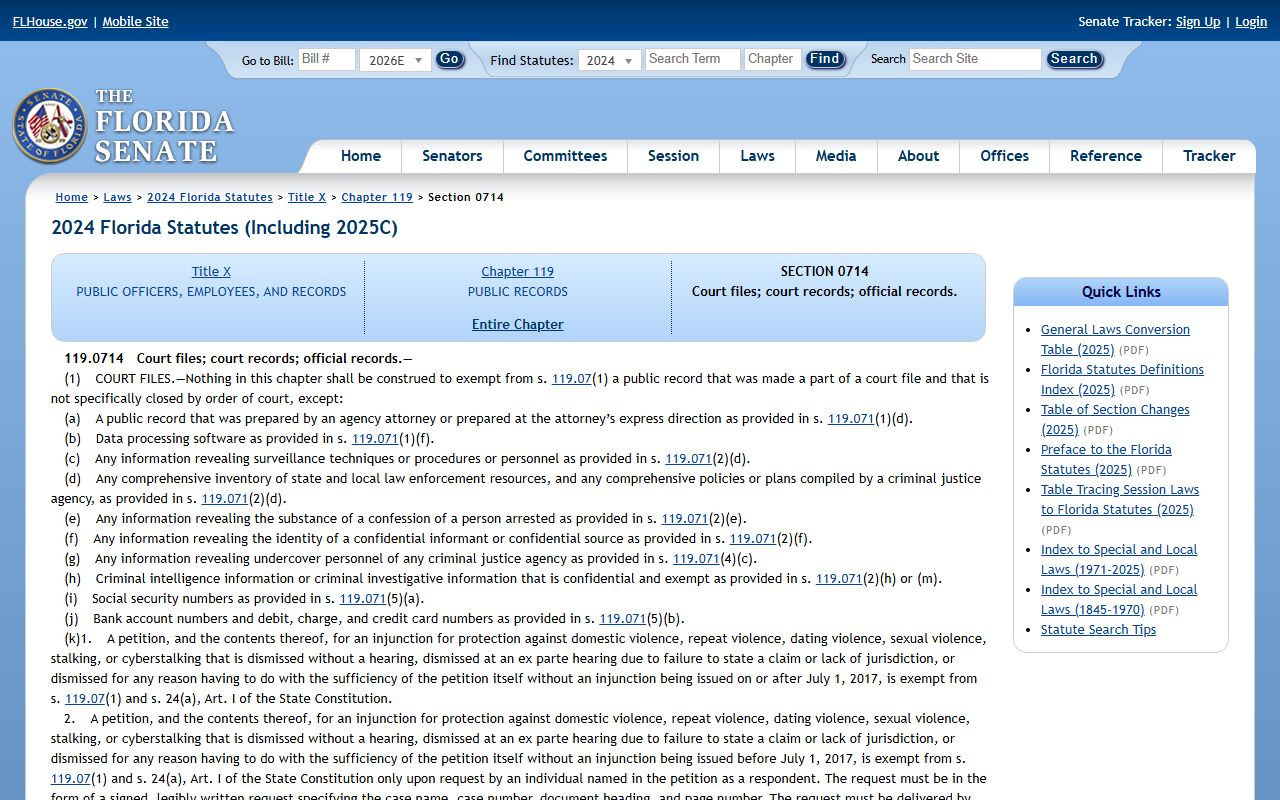
The text of Florida Statutes § 119.0714 on the Florida Senate site specifically addresses court files, court records, and official records held by Clerk offices such as Polk County's.
Records That Are Exempt from Disclosure
Florida law lists many exemptions, and Florida Statutes § 119.071 contains the main general exemptions from public inspection. Law enforcement investigative records may be exempt while the investigation is active. Victim identifying information is restricted under Marsy's Law and several statutes. Employee home addresses, medical records, and security plans may also be exempt. Court-record exemptions follow a different track. Florida Rule 2.420 defines confidential judicial branch records and sets the procedures the Clerk and courts use to protect them.
- Juvenile records
- Delinquency and juvenile criminal history are limited under § 943.0515; access is restricted to authorized agencies, parties, and attorneys.
- Dependency records
- Confidential under § 39.0132; access generally limited to parties, attorneys, guardians, and authorized agencies.
- Adoption records
- Confidential under § 63.162; unsealing generally requires a court order or statutory procedure.
- Mental health / Baker Act records
- Clinical records are confidential under § 394.4615 with limited exceptions.
- Sealed and expunged records
- Criminal history records sealed under § 943.059 or expunged under § 943.0585 are not accessible through the public court search.
- Sensitive filing data
- Florida Rule 2.425 limits full Social Security numbers, account numbers, minors' names, and birth dates in filed court documents.
An agency that refuses a request must name the specific statutory or rule provision it relies on. A vague or unexplained denial can be challenged. If you receive a refusal and are not sure whether it is valid, the Florida Attorney General's office and the Florida First Amendment Foundation both publish guidance on common exemptions and how to respond to a denial.
If Your Request Is Denied
A denial of a Polk County public records request is challengeable in circuit court. Chapter 119 allows any person to file a civil suit to enforce the right of access. If the court finds the agency wrongfully withheld records, it may award attorney's fees and costs to the requester. That fee-shifting provision is a real incentive for agencies to respond properly rather than refuse without cause.
Before going to court, try clarifying your request. Sometimes a request is refused because it is too broad or does not describe the records with enough detail for the agency to find them. A more specific description may unlock a response. If the agency cites an exemption you think is wrong, you can ask the Florida Attorney General's office to issue a formal opinion on whether the exemption applies. Those opinions are not binding on courts but carry persuasive weight and sometimes prompt agencies to reconsider.
For court records specifically, Rule 2.420 sets out a separate process for requesting access to judicial branch records that the Clerk has designated as confidential. That process involves a written request to the court, a chance for affected parties to object, and a ruling by the judge. It is distinct from the standard Chapter 119 process and generally slower, but it is the proper path when the record is a court file.
Official Records vs Court Records in Polk County
People often use the terms interchangeably, but they are different things in the Clerk's system. Court records are the files generated by court cases: a lawsuit, a criminal charge, a divorce petition, a probate matter. They live in the Clerk's court record portals. Official records are documents recorded with the Clerk for permanent public notice: a deed when property changes hands, a mortgage when a loan is secured, a lien when a contractor is unpaid, a final judgment when a creditor records a court victory against a debtor.
The official records browser at apps.polkcountyclerk.net/browserviewor/ searches official records going back to January 1, 1957. The system uses a Book/Page format for older records and a file number format of four-digit year plus six-digit sequence for newer ones. Court case records are found in either Polk Records Online for civil matters or the criminal and traffic portal for criminal and traffic cases. Knowing which system to use saves time. Florida Statutes § 28.2221 governs electronic access to official records and includes protections for personal information in those records.
Note: if you are searching for a recorded final judgment as a lien against a property, use the official records browser, not the court case portal; the two systems are separate.