
Arrest Records in Polk County
An arrest record starts when the Polk County Sheriff's Office or a municipal police department takes a person into custody. The Sheriff's Processing Center at 7101 De Castro Road, Winter Haven, books all arrestees entering the Polk County Jail. Intake Records Specialists generate a hard file and a computer file at booking. That booking record includes the inmate's name, booking number, charges at the time of arrest, the arresting agency, bond information, and demographic data. The record is created before any court case exists. If charges are later filed in court, the Clerk opens a separate case file in the criminal and traffic portal, and the court case is tracked there.
The Polk County Sheriff's Office is led by Sheriff Grady Judd. The main operations center is at 1891 Jim Keene Blvd., Winter Haven, FL 33880, phone 863-298-6200. The Records section is reached at 863-298-6300. Arrest records and booking information for the Polk County jail system come from PCSO. City police departments such as the Lakeland Police Department make their own arrest records, which may route into the Clerk's system once charges are filed in county or circuit court.
How to Search Polk County Arrest Records
Two primary portals cover Polk County arrest records for different stages of the process. The Sheriff's jail inquiry covers current custody and allows booking-year searches going back to 1999. The Clerk's criminal and traffic portal, reached through the Criminal & Traffic Records page, covers the court case after charges are filed. Both are free and allow public access without an account. For statewide criminal history beyond Polk County, the Florida Department of Law Enforcement (FDLE) maintains a separate criminal history database.
- Go to the Sheriff's jail inquiry page and enter the person's last name under the Name Search tab. Check "Show AKA names" if you want to include aliases. Use the Booking Date tab to search by year if you know approximately when the booking occurred.
- Review the results. The roster shows booking number, booking date, facility, charges at booking, arresting agency, and bond information. The disclaimer notes arrest does not mean conviction; get the final case outcome from the Clerk.
- Go to the Clerk's Criminal & Traffic Records page and select Public Search or Login to enter the court portal. Enter the same name or a case number if you have one from the jail inquiry.
- Open the case in the portal. The progress docket shows charges filed by the State Attorney, court dates, pleas, and the final disposition. This is the criminal court record, distinct from the arrest record.
- For statewide criminal history, contact FDLE at 850-410-8161 or use the FDLE criminal history request process. FDLE maintains the official state criminal history under Florida Statutes § 943.053 and may have records from other Florida counties beyond Polk.
The Sheriff's jail inquiry warns that results are limited to the first 1,000 matches. Refine the search criteria if your result set is that large. For names with an apostrophe, such as O'Keefe, the jail inquiry requires you to type two apostrophes: O''Keefe. That is a known quirk of the system.
Jail Inquiry vs. Criminal Court Records
The Sheriff's jail inquiry and the Clerk's criminal court portal are separate systems. They cover different stages of a criminal case and are not interchangeable. The jail roster shows what happened at booking. The court case shows what happened after charges were filed. A person may appear in the jail inquiry without having a court case if charges were not filed or were dropped before the case was opened. And a person with a court case in the Clerk's system may no longer appear in the jail roster if they have been released. The table below shows the key differences.
| Sheriff Jail Inquiry | Clerk Criminal/Traffic Portal | |
|---|---|---|
| Source | Polk County Sheriff's Office | Clerk of the Circuit Court & Comptroller |
| Created when | At booking / arrest | When charges are filed in court |
| What it shows | Name, charges at booking, facility, bond, arresting agency | Progress docket, court dates, filed charges, plea, disposition, sentence |
| Conviction information | No; booking charges only, no outcome | Yes; disposition and judgment entries reflect conviction or dismissal |
| Search URL | polksheriff.org/detention/jail-inquiry | showcase.polkcountyclerk.net |
| Anonymous access | Yes | Yes |
The Sheriff's own disclaimer states that case dispositions must be obtained from the Polk County Clerk. For Polk County inmate records showing current custody, use the jail inquiry. For the criminal case record and its outcome, use the Clerk portal.
Charges vs. Convictions in Polk County Criminal Records
A charge is an accusation. A conviction is a finding of guilt. The two are not the same, and Polk County criminal records reflect both because both are public. The progress docket in the Clerk's criminal portal shows charges when they are filed and shows the disposition when the case ends. Someone with a charge on record is not necessarily convicted. The charge may have been dismissed, reduced, or acquitted. The comparison below shows the distinction at each stage.
| Charge | Conviction | |
|---|---|---|
| What it is | A formal accusation filed by the State Attorney in court | A finding of guilt by verdict or guilty plea accepted by the court |
| Legal standard | Probable cause that the person committed the offense | Proof beyond a reasonable doubt at trial, or a voluntary guilty or no-contest plea |
| Effect on record | Appears in the public criminal docket when filed | Appears as a disposition entry; determines sentencing |
| Possible outcomes | Dismissed, reduced, acquitted at trial, or results in conviction | Sentence imposed, probation, adjudication withheld, or appeal filed |
| Public record | Yes; the charge filing is part of the public docket | Yes; the judgment and sentence are part of the public docket |
| Removal from record | Eligible for expunction if no conviction and other criteria met | Generally cannot be expunged; sealing may be possible with adjudication withheld |
Reading the disposition entry is the only way to know the final outcome of a Polk County criminal case. Do not draw conclusions from the charges alone. A nolle prosequi entry means the State Attorney dropped the charge. "Dismissed with prejudice" means it cannot be refiled. An adjudication withheld is not a conviction under Florida law for many purposes. See the court dockets page for how to read disposition codes in detail.
FDLE Statewide Criminal History Search
The Florida Department of Law Enforcement maintains the official statewide criminal history repository for Florida under Florida Statutes § 943.053. An FDLE criminal history record may include arrests and dispositions from any Florida county, not just Polk. The Clerk's criminal portal covers only Polk County Circuit and County Court records. If you need to check for criminal history statewide, FDLE is the proper source. FDLE criminal history requests are subject to fees and are separate from the free Clerk search. Contact FDLE at 850-410-8161 for the current request process.
The FDLE sexual offender and predator search is a separate public registry maintained by FDLE for sex offenders and predators registered in Florida, including those in Polk County.
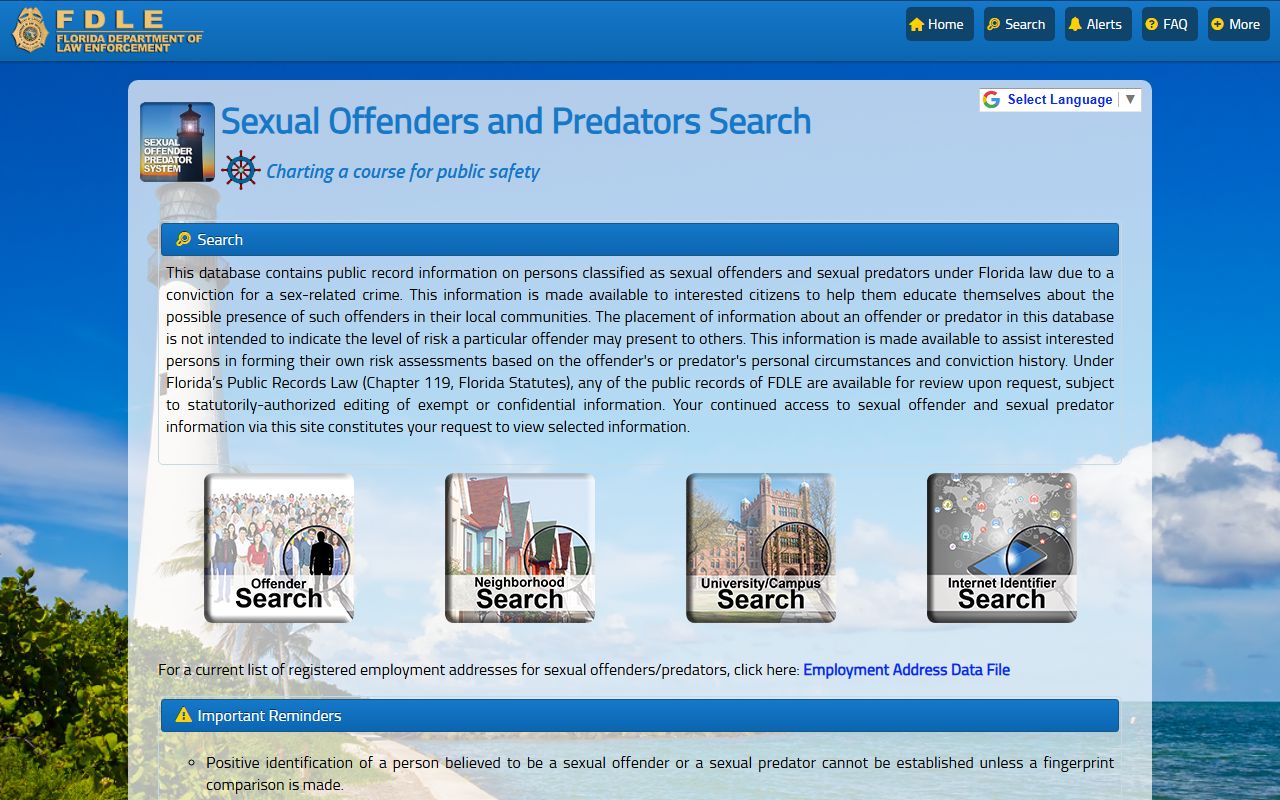
The FDLE sex offender and predator registry at offender.fdle.state.fl.us is a different tool from FDLE criminal history. The registry is a public database of registered sex offenders and predators. It can be searched by name, address, city, county, or ZIP code and includes Polk County registrants. FDLE warns that misuse of the registry is a criminal offense under Florida law. The registry does not replace a full criminal history; it only covers persons required to register as sex offenders or predators.
Sealed vs. Expunged Records in Polk County
Florida law provides two remedies for eligible persons who want to remove a criminal record from public view: sealing under Florida Statutes § 943.059 and expunction under § 943.0585. Both remedies are court-ordered processes that begin with a petition filed with the Clerk and served on the State Attorney. The Clerk's fee for sealing a court file or expungement of record is $42. Applicants must also obtain a certificate of eligibility from FDLE before filing the petition. The two remedies are not identical. The table below shows the main differences.
| Sealed Record | Expunged Record | |
|---|---|---|
| Governing statute | Fla. Stat. § 943.059 | Fla. Stat. § 943.0585 |
| Effect on public access | Record is removed from public view but preserved in the file | Record is removed from ordinary public access; physical records may be destroyed per FDLE direction |
| Law enforcement access | Limited access for specified agencies and uses | Very limited; fewer authorized users than sealed records |
| Eligibility requirement | Generally requires withheld adjudication, no prior sealing or expunction, no disqualifying offense | Generally requires no adjudication of guilt, no prior sealing or expunction, no disqualifying offense, FDLE certificate required |
| Right to deny | Person may lawfully deny the arrest in many settings; exceptions apply | Person may lawfully deny the arrest in many settings; fewer exceptions than sealed records |
| Exceptions to denial right | Law enforcement, Bar admission, certain licensing, criminal justice employment, some other contexts | Fewer exceptions; see statute for current list |
| Polk County Clerk fee | $42.00 | $42.00 |
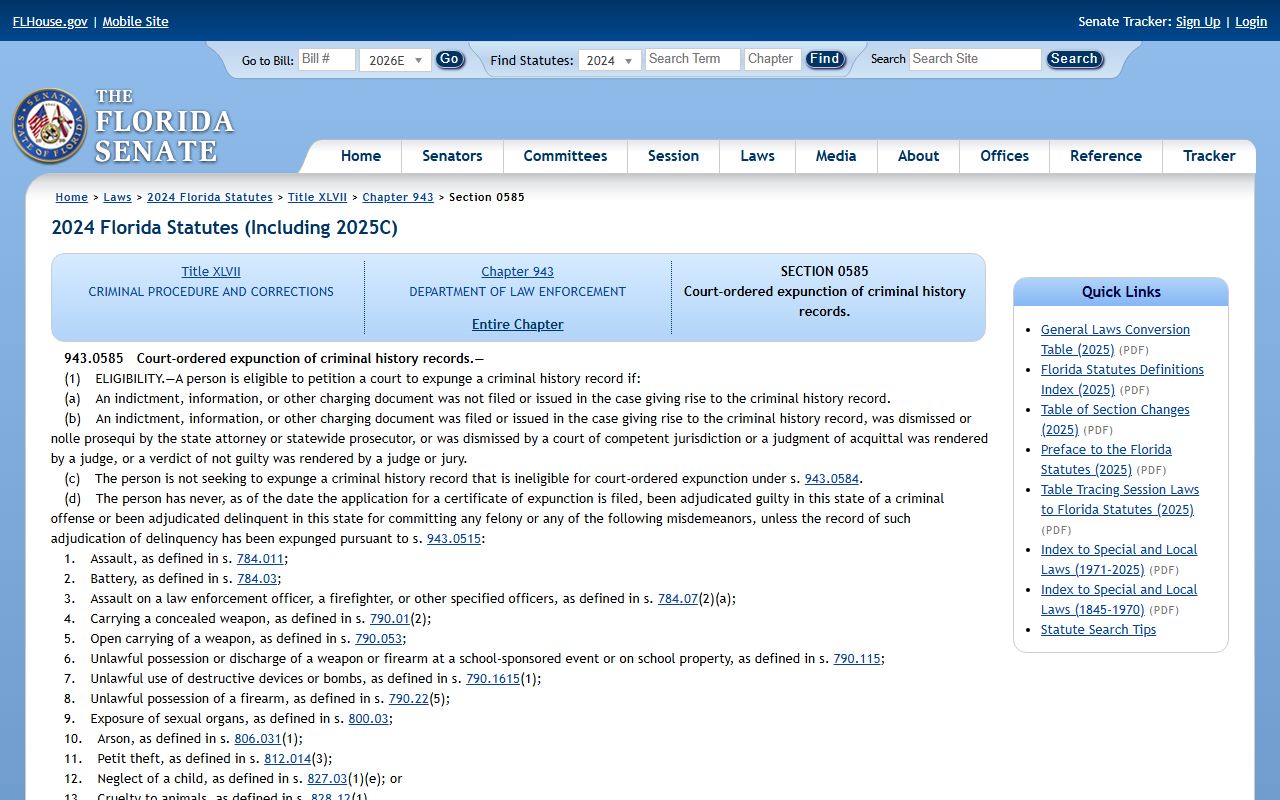
The Florida Legislature's official text of Florida Statutes § 943.0585 explains the full court-ordered expunction process, eligibility criteria, and effects on criminal history records.
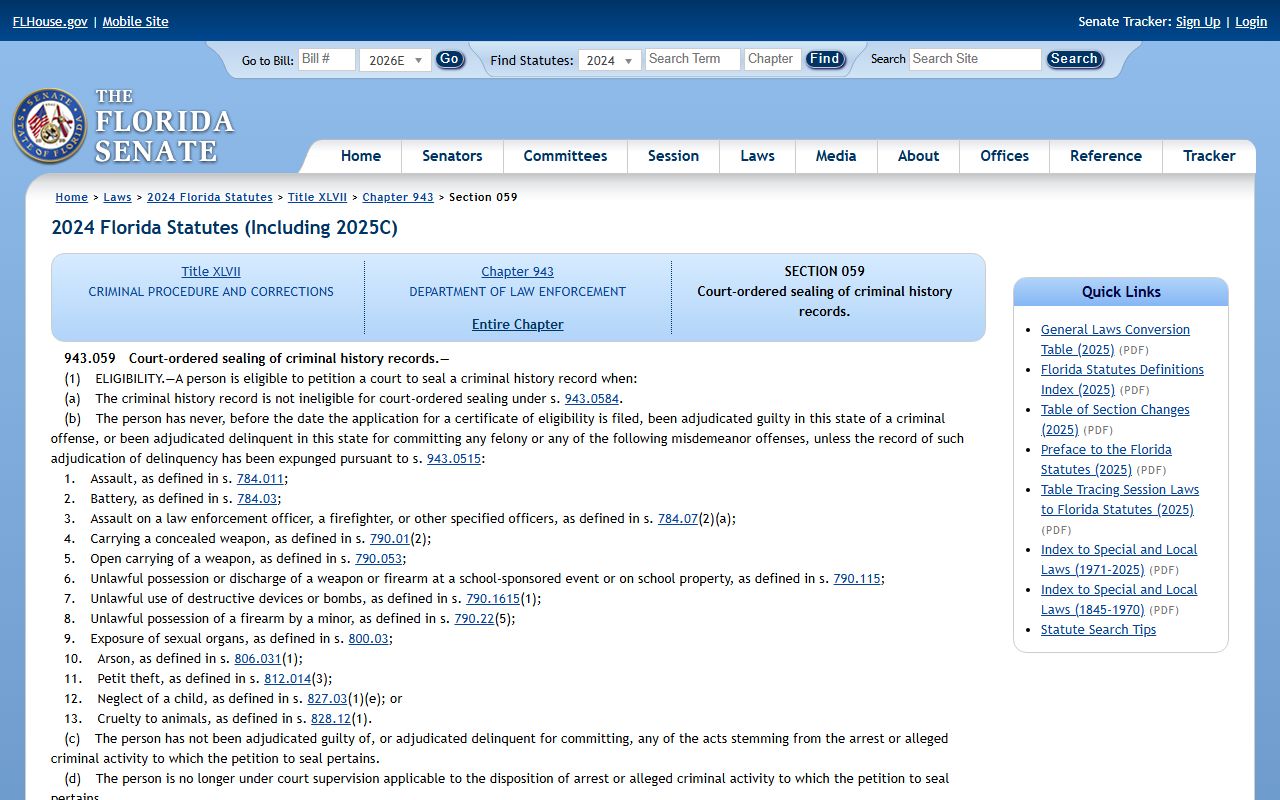
The Legislature's page for Florida Statutes § 943.059 covers court-ordered sealing of criminal history records, which restricts public access while preserving the record for authorized uses.
Common reasons a sealing or expunction petition is denied include a disqualifying offense on the record, a prior sealing or expunction, a missing FDLE certificate of eligibility, pending supervision, or an adjudication of guilt where a withheld adjudication is required. Juvenile expunction follows different rules under § 943.0515. For sealing or expunction information specific to Polk County, the Clerk's expungement page provides local process details. The petition is filed in the court that handled the original case.
Mugshots and Booking Photos in Polk County
Booking photos are taken at the Sheriff's Processing Center when a person is booked into the Polk County Jail. The jail inquiry may include mugshots as part of the inmate profile for currently or recently booked individuals. Florida does not have a single statewide law prohibiting the public posting of booking photos, and they are generally considered public records at the time of booking. However, Florida law and court rules restrict continued display of booking photos in some contexts, and several states have enacted "mugshot removal" statutes. Check current Florida law for any developments after this content was published.
If a person's record was later sealed or expunged, the Clerk's system removes the record from public view under the court order. However, private websites that collected and posted the booking photo before the sealing or expunction are not directly governed by the Clerk's order. Addressing photos on third-party sites requires separate legal steps. The Clerk's expungement page and the Public Defender, Tenth Judicial Circuit can offer direction on the process.
State Attorney and Public Defender in Polk County
Every criminal case in Polk County involves the State Attorney's Office on the prosecution side and, if the defendant qualifies for appointed counsel, the Public Defender's Office on the defense side. Both offices are part of the Tenth Judicial Circuit, which covers Polk, Highlands, and Hardee Counties.
The State Attorney's Office, Tenth Judicial Circuit, prosecutes felony, misdemeanor, and juvenile delinquency cases filed by law enforcement agencies in Polk County. The State Attorney decides whether to file charges, what charges to file, and whether to offer plea agreements or diversion. The State Attorney's name for the charge, which is called an "information" or, in more serious cases, an indictment, is the document that opens the court case and triggers the Clerk's case file. After a nolle prosequi is filed by the State Attorney, the case closes in the Clerk's system.
The Law Office of the Public Defender, Tenth Judicial Circuit, represents indigent defendants who cannot afford private counsel and are facing eligible criminal charges. Appointment follows an indigency application and a court determination. The Public Defender appears in the docket once appointed and can be a useful resource for persons navigating a Polk County criminal case. The Clerk fee schedule includes a public defender application fee governed by the Florida Legislature. For legal advice on a pending criminal matter, contact the Public Defender's office directly.
Note: the Public Defender represents defendants in court; they cannot help with records searches or sealing and expunction petitions for people who no longer have a pending case.
Restricted Polk County Criminal Records
Several categories of Polk County criminal records are not available in the public search. Juvenile delinquency records are restricted under Florida Statutes § 943.0515 and related juvenile court statutes. Access is limited to parties, attorneys, authorized agencies, and court order. Dependency and child-welfare cases are confidential under § 39.0132. Sealed criminal records are removed from the public portal under § 943.059 after a court order. Expunged criminal records are removed under § 943.0585. Active law-enforcement investigative records may be exempt from public disclosure while the investigation is open under Chapter 119.
Victim and witness identifying information is protected under Marsy's Law and Florida court rules including Rule 2.423. Grand jury proceedings are secret under Florida criminal procedure. Mental health and Baker Act records are confidential under § 394.4615. These protections apply across the Clerk's systems; records falling into these categories will not appear in a standard public criminal or traffic docket search.
Background Check Considerations for Polk County Criminal Records
The Polk County Clerk's criminal and traffic portal and the Sheriff's jail inquiry are public-service tools for general information. They are not consumer reporting agencies under the Fair Credit Reporting Act (FCRA). Using Polk County criminal records data for employment screening, tenant screening, credit decisions, or similar regulated purposes requires going through an FCRA-compliant consumer reporting agency, not through the Clerk's public portal or the jail inquiry.
Important: Information from public court portals and jail inquiries is not suitable for FCRA-regulated decisions. Use a licensed consumer reporting agency for employment, housing, or credit background checks involving Polk County criminal records.
For criminal background checks on individuals, FDLE provides Florida criminal history through its official process under § 943.053. That process does have fees and specific use requirements. Employers and others with a statutory right to access criminal history beyond the public search should consult FDLE's procedures and any applicable state or federal licensing requirements for background check programs.
Warrants and Capias in Polk County Criminal Records
A capias is a Florida court order to take a person into custody. It appears in the Clerk's criminal docket when a person misses a court date, violates probation, or fails to comply with a court order. A capias shows as an open entry in the progress docket until it is recalled by the court or executed by law enforcement. The Polk County Sheriff's warrant inquiry at polksheriff.org/detention/warrants-inquiry maintains a separate database of possible active warrants held by PCSO. Those are not the same as the Clerk's docket entries. For active warrant details, see the Polk County warrant records page.
An arrest warrant is issued under Florida Statutes § 901.02 when legal requirements are met. A bench warrant or capias is issued by the judge, often for failure to appear. A search warrant authorizes law enforcement to search a place or person and is generally not public before execution. If you have reason to believe an active warrant may exist for you, contact an attorney before approaching the court or the Sheriff. The Warrants Unit at PCSO can be reached at 863-298-6499 during normal business hours.