
What Probate Covers in Polk County
The Polk Clerk's Wills & Estates page describes probate as the legal process through which a deceased person's assets are distributed to heirs or beneficiaries. The court steps in to make sure debts are paid before the estate is distributed. If there is a valid will, the court supervises its execution. If there is no will, Florida's intestacy rules determine who inherits. The scope of probate in Polk County extends beyond simple estates to include guardianship of minors, guardianship of incapacitated adults, and certain mental health-related proceedings.
Probate cases in Polk County are assigned to the Probate Division of the Circuit Court. The Tenth Judicial Circuit, which covers Polk, Hardee, and Highlands Counties, lists Probate as one of five circuit divisions alongside Civil, Criminal/Felony, Family, and Juvenile. There is no separate probate court building or address; all filings go through the Clerk of the Circuit Court & Comptroller at the main courthouse in Bartow.
Probate can take several forms. Formal administration is the full court-supervised process. Summary administration is available for smaller estates or when the decedent has been dead more than two years. Disposition without administration allows heirs to collect certain assets directly without formal proceedings. Ancillary probate covers Florida assets of a person whose estate is being probated in another state.
Probate Terms Defined
Probate documents use terms that are not common in everyday language. Reading a petition or order is much easier once you know what these words mean. The definitions below match the way these terms are used in Florida Circuit Court filings.
- Testator
- The person who wrote and signed the will. If the testator has died and left a valid will, probate may be needed to carry it out.
- Personal representative
- Florida's term for the person named in the will (or appointed by the court if there is no will) to handle the estate. Other states use "executor" or "administrator" for the same role.
- Intestate
- Dying without a valid will. When a Polk County resident dies intestate, the court applies Florida's intestacy statutes to decide who inherits the estate.
- Guardianship
- A court-supervised arrangement in which a guardian is appointed to make personal decisions for a minor or an adult who lacks the capacity to manage their own affairs. Guardianship cases are filed in the probate division.
- Conservatorship
- A related proceeding focused specifically on managing the property and finances of a person who cannot do so themselves. Florida often handles both personal and financial oversight within a single guardianship proceeding.
- Letters of administration
- The court document that gives the personal representative legal authority to act on behalf of the estate, collect assets, pay debts, and distribute property.
Depositing a Will with the Polk Clerk
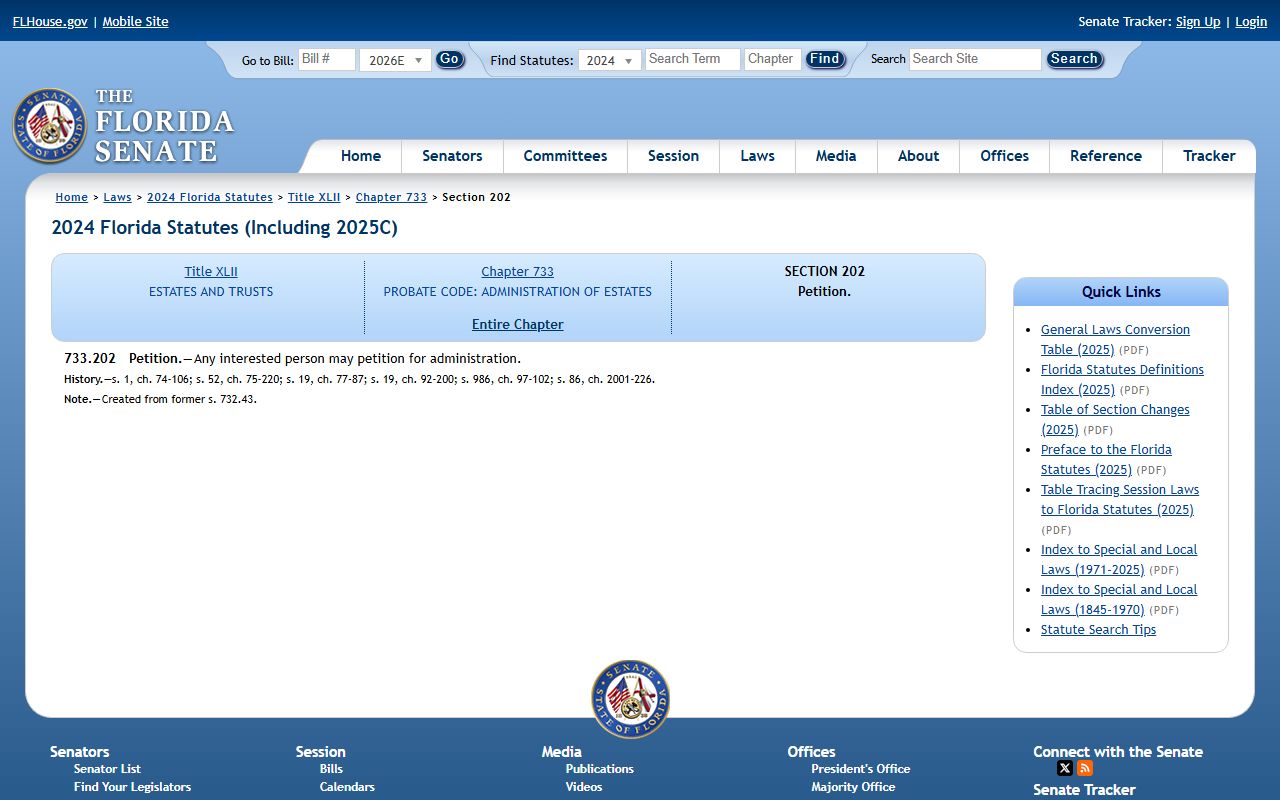
Anyone who holds a will after the person dies has a legal duty to file it promptly. Under Florida Statutes § 733.202, the custodian of a will must deposit it with the Clerk of the Circuit Court within 10 days after receiving information that the person has died. That deadline applies even if no one plans to open a probate estate. The will becomes part of the public record once filed.
The Florida Statutes § 733.202 page sets the 10-day filing deadline that applies to anyone holding a will after a Polk County resident dies.
When bringing in a will, the custodian should also provide the decedent's date of death and Social Security number if available. That information helps the Clerk create the correct case record and link the will to any subsequent probate petition.
This service is available only at the main courthouse in Bartow. The Clerk's Lakeland office and the Northeast-Lake Alfred office do not accept original will deposits. If you are traveling from another part of Polk County, plan your trip to the Bartow location. There is county parking nearby at 360 W. Church St., Bartow, at $2 for the first hour.
Note: Depositing a will with the Clerk does not open a probate case; it simply places the will on file; a separate petition for administration is required to start formal or summary probate.
Where to File Probate Records in Polk County
All probate filings in Polk County go to the main courthouse through the Clerk's office. The Probate Division of the Circuit Court holds hearings there. Below is the contact and location information for probate filings and original will deposits.
Clerk of the Circuit Court & Comptroller
Probate Division (Circuit Court)
255 North Broadway Avenue
Bartow, FL 33830
863-534-4000
Original wills: Bartow only (not Lakeland or Lake Alfred)
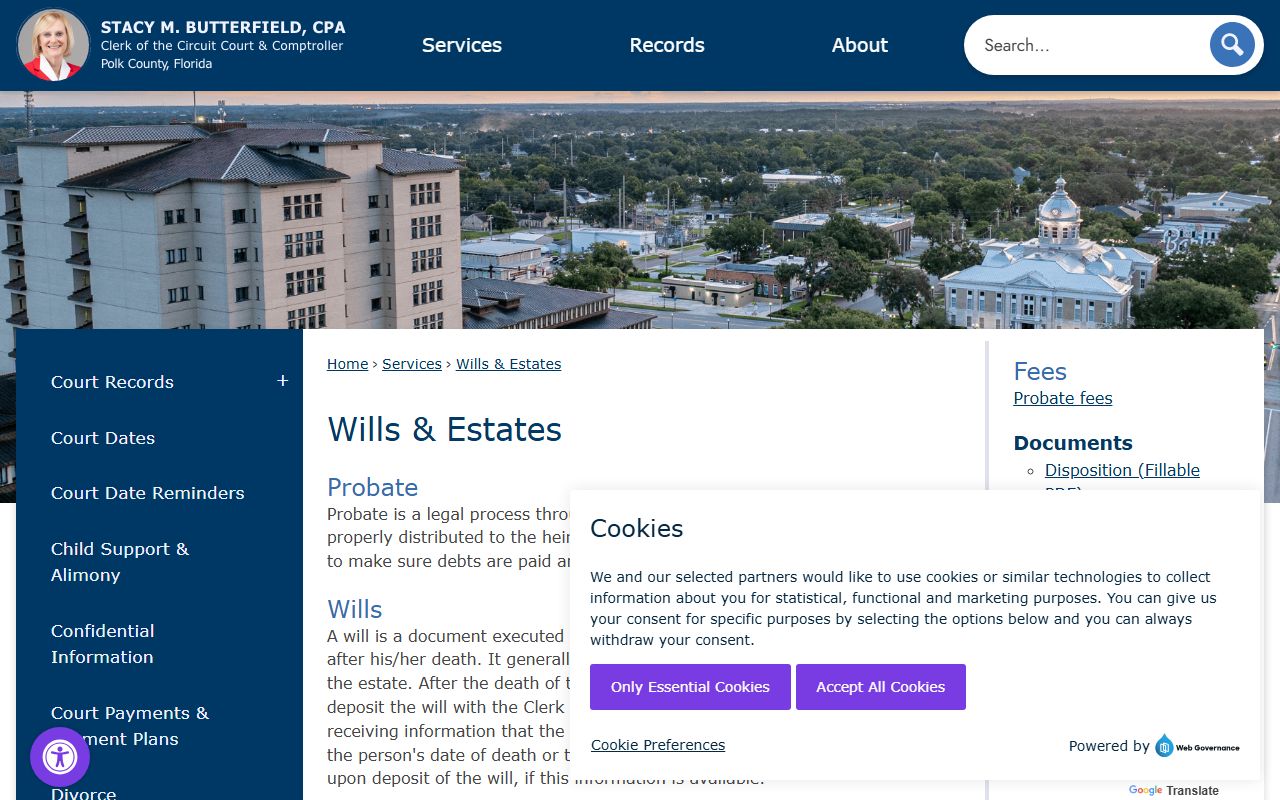
The Clerk's Wills & Estates page is the official source for probate forms and filing instructions. Two fillable PDF forms are listed there: a Disposition form and a Statement of Claim Probate form. Both can be downloaded from the Clerk's document center before your visit.
How to Search Polk County Probate Records
Probate cases are civil cases and are searched the same way as other civil court matters. The Clerk's civil portal, Polk Records Online (PRO), is the main tool. You can search by the decedent's name as a party, by the personal representative's name, or by case number if you have it. The official records browser at apps.polkcountyclerk.net may also contain recorded final judgments or other instruments tied to a probate matter.
The search-field table below shows the fields available when searching probate records through the civil portal and the official records system.
| Field | Type | Required | Notes |
|---|---|---|---|
| Party name | Text | Yes for name search | Search the decedent's name, the personal representative, or any interested party. |
| Case number | Text | Optional if known | Use the PRO civil search with the probate case number when available. |
| Document type | Checkbox / text in official records | Optional | In the official records browser, filter by document type to find recorded probate instruments. |
| Date range | Date (MM/DD/YYYY) | Optional | Useful when party names are common; narrow by the approximate date of death or filing. |
Some documents in PRO must be requested and reviewed by a clerk before they are available online. Guardianship files, in particular, may contain restricted information about minors or incapacitated adults that is not publicly viewable without a formal request.
How Estate Administration Works in Polk County
Opening and closing a probate estate follows a defined sequence. The Clerk's Wills & Estates page and Florida's probate rules set out the steps. The timeline depends on the size and complexity of the estate, the number of creditors, and whether the will is contested.
- Determine the type of administration needed. Formal administration is required for most estates. Summary administration is an option for smaller or older estates. Disposition without administration handles specific limited assets directly. Ancillary probate applies to Florida assets of a non-Florida resident.
- Deposit the original will. If there is a will, the custodian must bring it to the Polk County Courthouse in Bartow within 10 days of learning of the death, per § 733.202. No copies accepted; the original must be filed.
- File the petition and required documents. The personal representative or an attorney files a petition for administration along with the death certificate, the original will (if not previously deposited), oath of personal representative, designation of resident agent, and proposed letters.
- Court appoints the personal representative. The Circuit Court's Probate Division reviews the petition and issues letters of administration, giving the personal representative legal authority to act.
- Publish creditor notices and handle claims. Florida law requires notice to creditors. Creditors then file statements of claim. The personal representative reviews each claim and pays valid ones from estate funds.
- Inventory and manage assets. The personal representative files an inventory of estate assets. Disputed claims or will contests are resolved by the court at this stage.
- Distribute the estate. After debts and valid claims are paid, remaining assets go to beneficiaries named in the will or, if no will, to heirs under Florida's intestacy rules.
- File the final accounting and obtain discharge. The personal representative files a final accounting showing all receipts, payments, and distributions. The court enters an order of discharge, closing the estate.
What Polk County Probate Records Show
A complete probate file can be large. The types of documents that appear in a Polk County probate case include the petition for administration, the death certificate, the original will, the oath of the personal representative, the designation of resident agent, proposed letters and issued letters, creditor notices, statements of claim filed by creditors, inventory of estate assets, accountings showing payments and distributions, court orders on contested matters, and the final order of discharge. Not all of these are in every file; smaller estates may have fewer documents.
The Polk Clerk Wills & Estates page explains the will deposit process, probate filings, and available forms for Polk County estates.
Guardianship files may include additional restricted documents. Courts sometimes seal portions of a guardianship file when it contains medical information about an incapacitated adult or detailed financial information about a minor. For those records, a formal request through the Clerk or a court order may be required to access certain sections.
Restricted Probate Records
Most probate records are public. There are exceptions. Guardianship files involving minors or incapacitated adults may have restricted sections because they often contain sensitive medical, psychological, or financial data. Mental health proceedings within the probate division carry additional confidentiality protections under Florida law. Some records are viewable in PRO only after a clerk's review.
If you run a search in Polk Records Online and a document is marked as requiring review, contact the Clerk's records request team at polkcountyclerk.net/330/Request-Record-Copies. Staff can explain what is available and what steps are needed to access restricted portions. In some cases, a court order is required before restricted documents can be released.