
How to Look Up Polk County Jail Population Data
Polk County does not publish a real-time online population dashboard at a single public URL. Population-level data for the Polk County jail system is found across several sources. The Polk County Sheriff's Office posts general detention information at polksheriff.org/detention, but live aggregate population counts are not displayed there. County budget documents and the PCSO annual report contain historical population and capacity figures. The Florida Department of Corrections publishes statewide monthly statistical reports through its offender search system, which covers state prison inmates, not county jail populations. The Bureau of Justice Statistics, part of the U.S. Department of Justice, publishes the Annual Survey of Jails and the Census of Jails, which cover county facilities and include Florida jail data.
The most reliable official route for Polk-specific data is the PCSO directly. Calling the Sheriff's Operations Center at 863-298-6200 or making a public-records request to the Polk County Sheriff's Office under Florida Chapter 119 can yield current population and capacity figures. Annual reports published by the PCSO or by Polk County's Board of County Commissioners budget office may also include detention population summaries. For statewide jail context, the BJS jail survey data and Vera Institute of Justice incarceration trend reports cover Florida counties and can place Polk's figures in perspective.
Polk County Jail Capacity Overview
The Polk County Sheriff's Office operates two housing facilities for the county jail system: Central County Jail in Bartow and South County Jail near Frostproof. All booking and release processing runs through the Sheriff's Processing Center in Winter Haven, which is an intake and administrative site, not a housing unit. Official rated capacity numbers for the housing facilities have not been published in accessible official HTML sources during research for this page. The table below reflects known facility roles and capacity status based on official PCSO contact and support division pages.
| Facility | Rated Capacity | Role | Source Note |
|---|---|---|---|
| Central County Jail, 2390 Bob Phillips Road, Bartow | Not published in reviewed official sources | Primary housing; receives classified inmates; handles legal mail | County-specific capacity: PCSO annual report or public records request recommended |
| South County Jail, near Frostproof | Not published in reviewed official sources | Secondary housing facility | County-specific capacity: PCSO annual report or public records request recommended |
| Sheriff's Processing Center, 7101 De Castro Road, Winter Haven | Intake and processing only; not a housing unit | All arrestees booked and released through this location | Not counted in housing capacity figures |
Note: Polk County jail capacity data is not available in reviewed public official HTML. Obtain current figures from the PCSO annual report or through a public records request to the Polk County Sheriff's Office.
Average Daily Population
Average daily population, or ADP, is the standard measure used to compare jail systems over time. It is calculated by dividing total annual inmate-days by 365. Florida publishes ADP data for county jails through the Florida Department of Corrections and the Florida Sheriffs Association, but Polk County-specific current ADP was not found in accessible public HTML during research for this page. National context from the Bureau of Justice Statistics shows that local jails in the United States held an average of approximately 660,000 people on any given day in recent survey years, with some variation year to year due to COVID-related releases and subsequent recovery.
Polk County is a mid-to-large county by Florida standards. The Tenth Judicial Circuit page reports the circuit serves approximately 728,612 people across Polk, Hardee, and Highlands Counties. Polk is by far the most populous of the three. Counties of similar size in Florida typically hold between 1,500 and 3,500 people in jail on an average day depending on arrest rates, bond practices, case processing speed, and sentencing patterns. Official ADP from PCSO budget documents or the Florida Sheriffs Association jail survey should be used for any precise figure. Year-over-year change in ADP reflects shifts in booking volume, pretrial detention rates, case processing backlogs, and diversion program use.
Demographic Breakdown
Polk County-specific demographic data for the jail population, including gender, race, and age distributions, is not available from reviewed official public sources. PCSO annual reports or public records requests to the Sheriff's Office are the appropriate path to current Polk-specific demographic figures. National and state data from the Bureau of Justice Statistics provides comparative context for what jail demographics typically look like in Florida counties.
Across U.S. local jails, the Bureau of Justice Statistics consistently finds that adult males make up roughly 85 percent of the jail population. Women account for about 15 percent, a share that has grown over recent decades. Racial and ethnic distribution in Florida jails reflects the state's demographics but with overrepresentation of Black adults relative to population share, a pattern documented nationally in BJS surveys and by Vera Institute research. Age concentration falls most heavily in the 18-to-44 range. The table below uses national BJS jail survey approximations as context only; county-specific Polk figures should be obtained from PCSO.
| Demographic Group | Approximate National Share (BJS) | Polk County Status |
|---|---|---|
| Adult male | ~85% | County-specific figure not in reviewed sources; national figure shown for context |
| Adult female | ~15% | County-specific figure not in reviewed sources; national figure shown for context |
| Age 18-44 | ~65-70% | National pattern; Polk-specific age breakdown from PCSO records |
| Age 45 and older | ~25-30% | National pattern; Polk-specific age breakdown from PCSO records |
Pretrial vs. Sentenced Population
County jails hold two very different groups of people. Pretrial detainees are people who have been arrested but not yet convicted; they are in jail because they cannot post bond or a judge ordered no bond. Sentenced individuals have been convicted and are serving a sentence, typically for misdemeanors or short felony terms. The mix between these groups matters for understanding jail load. A jail dominated by pretrial inmates reflects bond practices and case processing speed more than it reflects sentencing decisions.
Nationally, the Bureau of Justice Statistics reports that pretrial detainees have made up a growing share of local jail populations over the past two decades, reaching approximately 70 percent or more of the average jail population in recent years. Florida's pretrial share follows a similar trend. Polk County's specific pretrial versus sentenced split was not located in reviewed official public HTML, but Polk's jail inquiry shows a mix of bookings that include both bond-eligible and no-bond cases. The table below uses national BJS data as a benchmark.
| Status | National Approximate Share (BJS) | Polk County |
|---|---|---|
| Pretrial (unconvicted) | ~70% | County-specific data from PCSO not in reviewed sources |
| Sentenced (convicted) | ~30% | County-specific data from PCSO not in reviewed sources |
Bond practices and first-appearance hearings shape the pretrial share directly. In Polk County, first appearances occur within 24 hours of arrest. A judge reviews probable cause and sets bond at that hearing. The Polk Sheriff's jail inquiry shows bond type and amount for each booking, which reflects the outcome of that initial hearing.
Misdemeanor vs. Felony Population
Florida county jails hold both misdemeanor and felony defendants. Misdemeanors are handled in the Polk County Court, the limited-jurisdiction court that sits under the Circuit Court in the Florida two-tier trial system. Felonies are Circuit Court matters. Sentenced misdemeanants often serve time in county jail rather than state prison. Felony defendants may be in county jail awaiting trial or, if sentenced to a term of more than a year, may transfer to Florida Department of Corrections custody after sentencing.
Polk County-specific data on the misdemeanor versus felony split in the jail was not located in reviewed official public HTML. A general pattern in Florida counties is that misdemeanor detainees represent a smaller share of the total jail population by headcount, while felony detainees, many of them pretrial, make up the majority. The charge type visible in each booking on the Polk Sheriff's jail inquiry can be used to examine the mix for any specific time period, but aggregate breakdowns require PCSO report data.
Mental Health and Medical Population
Jails across Florida serve as a de facto mental health system for people who cycle through arrest and release without access to community treatment. The Tenth Judicial Circuit created specialized felony mental health and competency divisions, reflected in the Polk County DUI/Drug Court administrative order signed in March 2024. Those programs aim to divert eligible defendants into treatment supervision rather than standard incarceration. Still, a substantial share of people in any Florida county jail have diagnosable mental health conditions or substance use disorders.
The Bureau of Justice Statistics has found that roughly a third to half of jail inmates nationally report a history of mental illness, and a larger share meet clinical criteria when assessed. Medical care in the Polk County jail is referenced on the PCSO inmate accounts page, which notes that nurse, doctor, dental, and pharmacy fees apply and vary by service. That cost structure suggests medical care is provided on-site. Polk County-specific data on the share of the jail population receiving mental health or medical services was not located in reviewed official public HTML. Requests to the PCSO or to the Florida Department of Health would yield more specific figures.
National and State Context
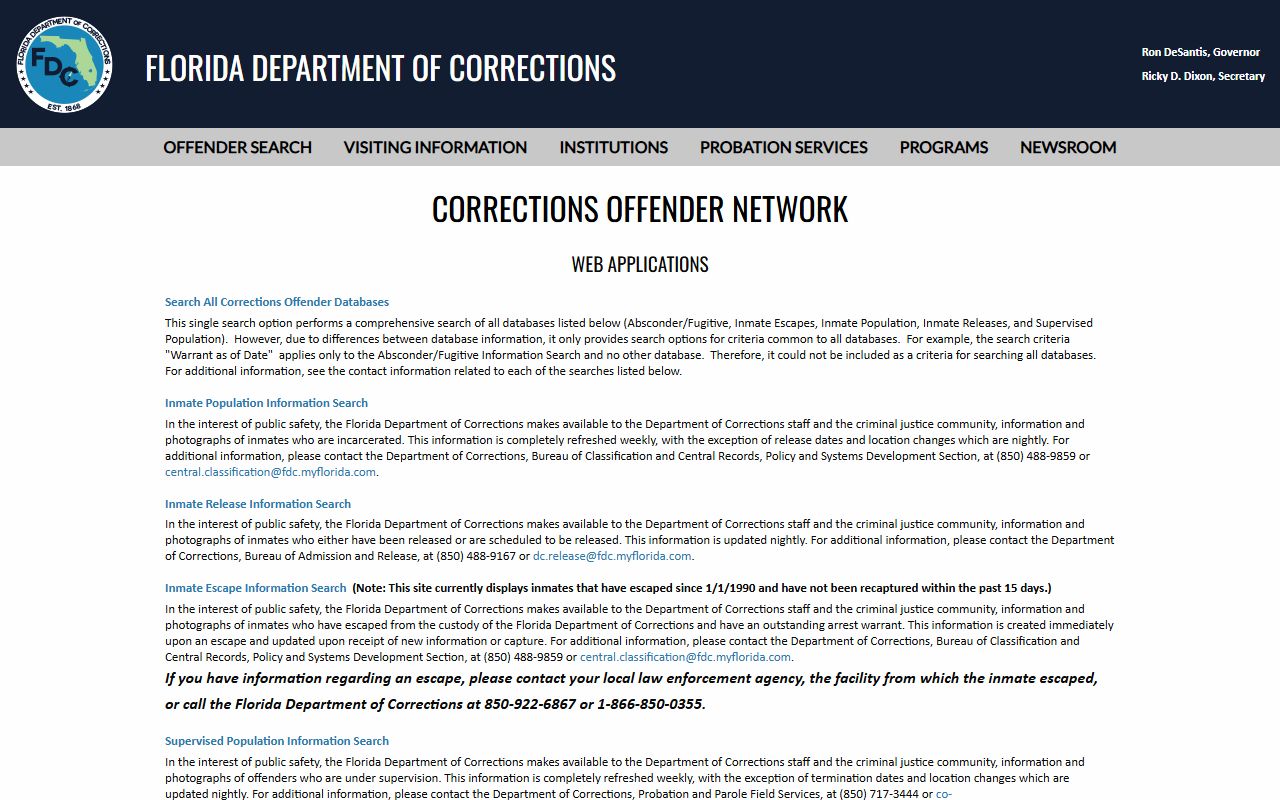
The Florida Department of Corrections publishes monthly statistical reports that show the size and composition of Florida's state prison system. These figures are separate from county jail populations but provide the most current official snapshot of incarceration in Florida. As of March 2026, the FDC monthly report shows a Florida state prison population of 90,230 people, with 138,631 on probation and 5,115 under post-prison supervision, for a total community supervision count of 143,746. Earlier months show a consistent pattern: October 2025 showed a prison population of 89,964, May 2025 showed 88,908, and June 2025 showed 89,087. These are state prison figures only and do not include the tens of thousands of additional people held in Florida county jails at the same time.
The FDOC offender search is the official data source for Florida state prison population figures, which provide statewide context for understanding Polk County's place in Florida's incarceration system.
The Bureau of Justice Statistics reported a national local jail population of approximately 633,000 in mid-2022, the most recent full Census of Jails data available. That translates to a national jail incarceration rate of roughly 190 per 100,000 U.S. residents. Florida's rate has historically tracked close to the national average, with variation by county. The table below shows the context frame; Polk County-specific figures from PCSO records should fill the county row when obtained.
| Level | Jail Population per 100,000 (approx.) | Source / Note |
|---|---|---|
| Polk County | Not available from reviewed official sources | Obtain from PCSO annual report or public records request |
| Florida (statewide) | Approximately 170-200 (county jails; varies by year) | BJS Annual Survey of Jails; Florida Sheriffs Association |
| United States (national) | Approximately 190 (mid-2022 BJS Census of Jails) | Bureau of Justice Statistics, Census of Jails 2022 |
Population Trends Over Time
Florida's county jail population, like that of most states, declined significantly in 2020 as facilities released low-risk inmates in response to COVID-19 health concerns and court slowdowns reduced new bookings. From 2021 through 2024, most Florida county jails saw gradual increases as courts resumed normal operations and booking volumes returned. The FDC monthly report data shows Florida's state prison population growing from roughly 88,900 in May 2025 to 90,230 in March 2026, a pattern consistent with overall system growth. County jail populations tend to track parallel trends, though the drivers differ: county jail volume responds more to local arrest rates and bond policy than to sentencing length decisions.
A five-year trend table for Polk County specifically was not located in reviewed official public HTML. The Vera Institute of Justice maintains incarceration trend data for U.S. counties at the county level, including Florida, which can place Polk's trajectory in historical context. BJS annual jail surveys, published with a one-to-two-year lag, also show Florida county-level data. The most accurate Polk-specific trend data would come from PCSO annual reports or from a public records request covering booking and population counts over the past several fiscal years.
Searching for Polk County Inmate Records by Name
Population data on this page covers the aggregate size and composition of the Polk County jail system, not individual inmate records. To search for a specific person currently in custody or booked in a prior year, use the Polk County inmate records page, which covers the Sheriff's jail inquiry tool, search field details, how the booking year search works, and how to read an individual inmate profile.
Where the Data Comes From
The data on this page draws from three categories of sources. First, official PCSO pages at polksheriff.org/detention and related contact and support division pages, which document the jail's facilities, fees, and operational structure. Second, Florida Department of Corrections monthly statistical reports, cited above with specific figures and dates. Third, Bureau of Justice Statistics publications, including the Annual Survey of Jails and the Census of Jails, which cover county facilities nationally and provide per-100,000 rate context. The Vera Institute of Justice publishes county-level incarceration trend analyses that draw on both BJS and administrative data and are useful for historical comparison.
Where county-specific data is not available from reviewed official sources, this page says so directly. The gaps noted here are research gaps, not missing data points to be filled with estimates. Anyone relying on Polk County population figures for policy, research, or legal purposes should obtain verified data from the PCSO, Polk County government budget documents, or BJS published surveys. Data on the Polk Sheriff's jail inquiry is operational-level data, not population reporting, and should not be used as a substitute for official population counts.